Brewing guide · Chronic.

Coffee brewing guide

Espresso, V60, moka pot, French press, AeroPress, cold brew: choose your method and follow the recipe step by step. Dose, water, temperature, grind, time. Everything you need to make a great cup at home, with the right coffee and the right equipment.

Methods explained
10
Filter ratio
1:16
Espresso ratio
1:2
Water for filter
92–96 °C
Brewing coffee in a French press

Espresso machine · Intense

Espresso

Short, dense, syrupy. Espresso concentrates all of the coffee into around thirty seconds. It's the most demanding method: every setting counts. Once you've dialled it in, it's a treat.

Espresso being extracted into a cup
Ratio
1:2
Coffee
18 to 20 g (double)
Water
36 to 40 g in the cup
Temperature
90 to 96 °C
Grind
Very fine
Time
25 to 30 s
The grind guide

On our coffeesChoose “Whole bean” if you have a grinder, otherwise “Ground - espresso”.

Equipment

  • Espresso machine
  • Coffee grinder
  • Tamper
  • Precision scale
  • Espresso cup

Steps

  1. Preheat the machine, the portafilter and the cup.
  2. Dose 18 to 20 g of freshly ground coffee into the basket.
  3. Distribute the grounds to get a nice, flat bed.
  4. Tamp level, with firm, even pressure.
  5. Flush the group head for a few seconds, then insert the portafilter.
  6. Start the extraction and weigh your cup: aim for about double the dose, so 36 to 40 g.
  7. Stop at around 25 to 30 seconds. Taste, then adjust the grind if needed.

Common mistakes

  • It runs too fast and tastes sourGrind too coarse: go one step finer.
  • It barely drips and tastes bitterGrind too fine: go one step coarser.
  • It runs on one side onlyUneven distribution or tamping: distribute carefully and tamp level.
  • Little or no cremaCoffee ground too long ago: grind just before brewing.

The roaster's tipChange only one parameter at a time. Keep the dose and ratio fixed, and adjust the grind first.

On video · Freddo espresso, the Greek iced coffee

The complete espresso guide

Coffees for your espresso

All espresso coffees
  • 10AM
    BEST SELLER BIO
    Guatemala
    Washed
    10AM

    from €15,95

    RaspberryChocolateNougat
  • 04PM
    BEST SELLER BIO
    Peru • Uganda
    Washed • Natural
    04PM

    from €11,95

    HazelnutCaramelMalt
  • 05AM
    BIO
    Uganda • Peru
    Washed • Natural
    05AM

    from €11,95

    ToastVanillaPeanut
  • 01PM
    BIO
    Ethiopia
    Washed
    01PM

    from €15,95

    LemonJasmineBrown sugar

Bean-to-cup machine · Easy every day

Bean-to-cup machine

A bean-to-cup machine, a JURA for example, grinds, tamps and extracts for you. Your job: give it fresh coffee and set it up properly. In the cup, the difference is huge.

JURA bean-to-cup coffee machine
Ratio
Handled by the machine
Coffee
Depending on the strength selected
Water
Fresh water, ideally filtered
Temperature
Normal to high setting
Grind
Very fine (built-in grinder)
Time
Bean-to-cup
The grind guide

On our coffeesAlways “Whole bean”: the machine grinds for you. Never put ground coffee in the bean hopper.

Equipment

  • Bean-to-cup machine
  • Fresh whole bean coffee
  • Fresh filtered water

Steps

  1. Fill the tank with fresh water, ideally filtered.
  2. Pour only a few days' worth of beans into the hopper, then close it tightly.
  3. Adjust the grind: on most machines, while the grinder is running (check your user manual).
  4. Start with a fine setting, then taste two or three coffees before changing it.
  5. Choose the strength and volume: the shorter the cup, the richer it is.
  6. Clean and descale at the intervals the machine asks for.

Common mistakes

  • Weak, watery coffeeGrind too coarse or volume too long: go one step finer, reduce the volume.
  • Bitter, burnt-tasting coffeeVery dark beans: choose a coffee designed for bean-to-cup machines.
  • Rancid tasteBeans left too long in the hopper: fill less, more often.

The roaster's tipAvoid very dark, oily beans: they clog the grinder and add bitterness. Our selection for bean-to-cup machines helps you choose.

A problem with your JURA? The guide

Coffees for bean-to-cup machines

All coffees for bean-to-cup machines
  • 10AM
    BEST SELLER BIO
    Guatemala
    Washed
    10AM

    from €15,95

    RaspberryChocolateNougat
  • 04PM
    BEST SELLER BIO
    Peru • Uganda
    Washed • Natural
    04PM

    from €11,95

    HazelnutCaramelMalt
  • 05AM
    BIO
    Uganda • Peru
    Washed • Natural
    05AM

    from €11,95

    ToastVanillaPeanut
  • 01PM
    BIO
    Ethiopia
    Washed
    01PM

    from €15,95

    LemonJasmineBrown sugar

Moka pot · Strong

Moka pot

An icon of Italian kitchens, the moka pot makes intense, rounded coffee, somewhere between espresso and filter. Three habits make all the difference: water already hot, coffee not tamped, gentle heat.

Bialetti moka pot on the stove
Ratio
About 1:7
Coffee
15 to 17 g (3 cups)
Water
Up to the valve
Temperature
Water already hot, medium heat
Grind
Fine
Time
4 to 6 min
The grind guide

On our coffees“Ground - moka pot” is made for this. If you have a grinder, choose “Whole bean”.

Equipment

  • Moka pot
  • Coffee grinder
  • Kettle
  • Spoon

Steps

  1. Fill the bottom chamber with hot water, up to the valve but not above it.
  2. Fill the filter basket to the brim with coffee, without tamping. Level it with your finger.
  3. Wipe the thread and screw the top on firmly.
  4. Place on medium heat, lid open.
  5. As soon as the coffee starts to flow, turn the heat down.
  6. Take it off the heat at the first gurgle, then close the lid.
  7. Stir in the pot and serve straight away.

Common mistakes

  • Bitter, burnt tasteHeat too high or extraction too long: take it off sooner.
  • The coffee doesn't riseGrind too fine or coffee tamped: go coarser, never tamp.
  • Coffee too weakFilter not full enough or grind too coarse.
  • Metallic tastePot not rinsed properly: rinse with clean water after each use.

The roaster's tipStart with water that's already hot: the coffee spends less time on the heat and keeps its sweetness.

The complete moka pot guide

Coffees for your moka pot

All coffees for moka pots
  • 04PM
    BEST SELLER BIO
    Peru • Uganda
    Washed • Natural
    04PM

    from €11,95

    HazelnutCaramelMalt
  • 05AM
    BIO
    Uganda • Peru
    Washed • Natural
    05AM

    from €11,95

    ToastVanillaPeanut
  • 01PM
    BIO
    Ethiopia
    Washed
    01PM

    from €15,95

    LemonJasmineBrown sugar
  • 11PM
    BIO
    Peru
    Washed
    11PM

    from €11,95

    Black pepperCocoaLight tobacco

Manual pour-over · Clean and aromatic

V60

The V60 makes a clean, light, aromatic cup. Its conical shape speeds up the flow: you control the extraction with the rhythm of your pour.

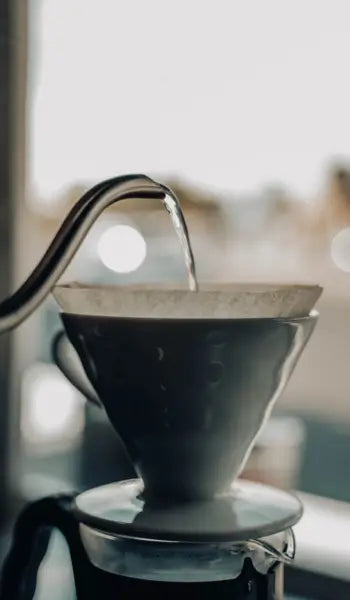
Pouring water into a V60 dripper
Ratio
1:16
Coffee
22 g
Water
360 g
Temperature
92 to 96 °C
Grind
Medium-fine
Time
2 min 30 to 3 min
The grind guide

On our coffeesChoose “Whole bean” and grind just before brewing: the V60 deserves a fresh, well-adjusted grind.

Equipment

  • V60 dripper and filters
  • Gooseneck kettle
  • Coffee grinder
  • Scale
  • Timer

Steps

  1. Place the filter in the V60 and rinse it with hot water. Discard the rinse water.
  2. Add 22 g of ground coffee and make a small well in the centre.
  3. Start the timer and pour 50 g of water for the bloom.
  4. After 30 seconds, pour slowly in circles, from the centre outwards.
  5. Keep a steady water level until the scale reads 360 g.
  6. Let it drain completely: 2 min 30 to 3 min in total.
  7. Remove the V60, swirl the carafe and serve.

Common mistakes

  • Sour, hollow coffeeIt runs too fast: grind finer.
  • Bitter, drying coffeeIt runs too slowly: grind coarser.
  • The coffee bed caves inPouring too hard: pour lower and more gently.

The roaster's tipWeigh your water rather than measuring it: 1 ml of water weighs 1 g. After the grinder, a scale is the best investment.

Which method is right for you?

Coffees for your V60

All filter coffees

Filter · Clean and elegant

Chemex / Orea

The Chemex and the Orea make a clear, clean cup. The Chemex's thick filter holds back as much oil as possible. The flat-bottomed Orea flows faster and is more forgiving.

Filter coffee brewed with an Orea dripper
Ratio
1:16
Coffee
30 g
Water
500 g
Temperature
92 to 96 °C
Grind
Medium-coarse (one step finer for the Orea)
Time
About 4 min
The grind guide

On our coffeesChoose “Whole bean” and grind just before brewing: no pre-ground coffee is set up for these filters.

Equipment

  • Chemex or Orea
  • Suitable filters
  • Gooseneck kettle
  • Coffee grinder
  • Scale
  • Timer

Steps

  1. Place the filter and rinse it with hot water. For the Chemex, thick side towards the spout.
  2. Discard the rinse water and add 30 g of ground coffee.
  3. Start the timer and pour 60 g of water for the bloom.
  4. After 30 seconds, pour gently in a spiral.
  5. Continue in several pours up to 500 g.
  6. Let it finish draining: about 4 minutes in total.
  7. Remove the filter, swirl the carafe and serve.

Common mistakes

  • Never-ending drawdownGrind too fine for a thick filter: go coarser.
  • Flat, dull coffeeWater not hot enough: aim for 92 to 96 °C.
  • Bitter coffeeTime too long: grind coarser or pour a little faster.

The roaster's tipFor 2 to 4 cups, keep the 1:16 ratio and simply adjust the quantities. If it runs too fast or too slowly, adjust the grind, not the dose.

On video · The Chemex in one minute

The complete Chemex guide

Coffees for your Chemex

All filter coffees

Immersion and pressure · Versatile

AeroPress

Versatile and almost unbreakable, the AeroPress goes from the gentlest to the most intense. Perfect for experimenting, at the office or on the road.

Coffee brewed with an AeroPress
Ratio
About 1:15
Coffee
17 g
Water
250 g
Temperature
80 to 90 °C
Grind
Fine to medium-fine
Time
About 2 min
The grind guide

On our coffeesChoose “Whole bean” and grind just before brewing so you can play with every setting.

Equipment

  • AeroPress and filters
  • Kettle
  • Coffee grinder
  • Scale
  • Spoon
  • Timer

Steps

  1. Place a filter in the cap and rinse it with hot water.
  2. Put the AeroPress on your cup and add 17 g of ground coffee.
  3. Start the timer and pour 250 g of water at 80 to 90 °C.
  4. Stir gently for 10 seconds.
  5. Insert the plunger a few millimetres to hold the coffee and let it steep for 1 minute.
  6. Press slowly, over 20 to 30 seconds.
  7. Stop as soon as you hear a slight hiss.

Common mistakes

  • Impossible to pressGrind too fine: go a little coarser.
  • Weak coffeeSteep too short or grind too coarse: add 30 s or go finer.
  • Bitter coffeeWater too hot for this coffee: go down to 80 to 85 °C.

The roaster's tipTry the inverted method, with the AeroPress upside down, for a longer steep. And adjust the ratio to your taste.

On video · The AeroPress in one minute

The complete AeroPress guide

Coffees for your AeroPress

All filter coffees

French press · Rich and generous

French press

Generous and easy to use, the French press makes rich, rounded coffee full of texture. The secret: a nice coarse grind and the patience to let it steep.

French press coffee maker
Ratio
1:12
Coffee
30 g
Water
360 g
Temperature
About 95 °C, not boiling
Grind
Very coarse
Time
4 min
The grind guide

On our coffees“Ground - French press” is made for this. If you have a grinder, choose “Whole bean”.

Equipment

  • French press
  • Kettle
  • Coffee grinder
  • Scale
  • Spoon
  • Timer

Steps

  1. Preheat the French press with hot water, then empty it.
  2. Add 30 g of coarsely ground coffee.
  3. Pour 360 g of hot, not boiling, water.
  4. Stir gently to wet all the coffee.
  5. Put the lid on without pressing and let it steep for 4 minutes.
  6. Slowly press the plunger all the way down.
  7. Serve straight away to avoid over-extraction.

Common mistakes

  • Muddy coffee, full of sedimentGrind too fine: use a very coarse grind.
  • Plunger hard to push downSame cause, grind too fine. Don't force it.
  • Bitter coffeeLeft too long on the grounds: serve straight away or decant.
  • Weak coffeeSteep too short: try 5 minutes.

The roaster's tipDon't press too hard and you'll avoid bitterness. For a cleaner cup, pour the coffee through a paper filter.

The complete French press guide

Coffees for your French press

All coffees for French press
  • 10AM
    BEST SELLER BIO
    Guatemala
    Washed
    10AM

    from €15,95

    RaspberryChocolateNougat
  • 04PM
    BEST SELLER BIO
    Peru • Uganda
    Washed • Natural
    04PM

    from €11,95

    HazelnutCaramelMalt
  • 05AM
    BIO
    Uganda • Peru
    Washed • Natural
    05AM

    from €11,95

    ToastVanillaPeanut
  • 01PM
    BIO
    Ethiopia
    Washed
    01PM

    from €15,95

    LemonJasmineBrown sugar

Electric filter · Consistent

Moccamaster

Precise and consistent, the Moccamaster extracts evenly. Ideal for several cups without compromise, as long as you get the grind and dose right.

Moccamaster filter coffee maker brewing
Ratio
About 1:15
Coffee
About 65 g
Water
1 litre
Temperature
Handled by the machine
Grind
Medium
Time
One full cycle
The grind guide

On our coffeesChoose “Whole bean” and grind just before brewing, at a medium grind.

Equipment

  • Moccamaster
  • No. 4 paper filter
  • Coffee grinder
  • Scale
  • Filtered water

Steps

  1. Rinse the filter and preheat the carafe.
  2. Pour fresh water into the tank.
  3. Add the coffee to the dry filter.
  4. Start the machine. If your model allows it, pause for about 30 s at 200 ml for the bloom, then restart.
  5. Gently stir the coffee bed during brewing for a more even extraction.
  6. Let the machine finish its cycle, remove the filter and serve.

Common mistakes

  • Bitter after a whileCarafe left on the hotplate: serve quickly.
  • Weak coffeeNot enough coffee: stay around 65 g per litre.
  • Chalky tasteHard water: use filtered water and descale regularly.

The roaster's tipThe Moccamaster gives consistent results, stress-free. But nothing stops you from playing barista with the grind.

The complete Moccamaster guide

Coffees for your Moccamaster

All filter coffees

Vacuum brewing · Spectacular

Siphon

Spectacular and precise, the siphon makes coffee of great purity, with clean aromas. It requires good control of heat and timing.

Siphon coffee maker mid-brew
Ratio
About 1:16
Coffee
About 60 g per litre
Water
400 to 500 ml depending on the model
Temperature
92 to 96 °C
Grind
Medium-fine
Time
1 min to 1 min 30 steeping
The grind guide

On our coffeesChoose “Whole bean” and grind just before brewing, like table salt.

Equipment

  • Siphon
  • Burner
  • Filter
  • Coffee grinder
  • Scale
  • Spoon
  • Timer

Steps

  1. Fill the bottom flask with hot water, 400 to 500 ml depending on the model.
  2. Place the filter in the upper chamber and set it on the flask.
  3. Light the burner on medium-high heat.
  4. Once the water has risen, add the ground coffee.
  5. Stir gently to wet all the coffee.
  6. Let it steep for 1 minute to 1 minute 30, stirring gently again after 45 seconds.
  7. Turn off the heat: the coffee drops back into the flask in 30 to 45 seconds.
  8. Remove the upper chamber and serve.

Common mistakes

  • Bitter coffeeSteep too long: turn off the heat sooner.
  • The coffee doesn't drop back downGrind too fine: it clogs the filter.
  • Flat coffeeCoffee not properly wetted: stir so it's all immersed.

The roaster's tipStart with water that's already hot: you save time and the water rises faster.

On video · The siphon in one minute

The complete siphon guide

Coffees for your siphon

All filter coffees

Cold brewing · Smooth

Cold brew

Steeped cold for hours, cold brew is smooth, refreshing and low in bitterness. You make a concentrate, then dilute it to taste.

Glass of cold brew over ice
Ratio
1:5 (concentrate)
Coffee
200 g
Water
1 litre of cold water
Temperature
Cold water
Grind
Very coarse
Time
12 to 24 h
The grind guide

On our coffees“Ground - French press” is perfect. If you have a grinder, choose “Whole bean”.

Equipment

  • Large jar or carafe
  • Paper or cloth filter
  • Coffee grinder
  • Scale
  • Spoon

Steps

  1. Mix 200 g of coarsely ground coffee with 1 litre of cold water in the container.
  2. Stir so all the coffee is well wetted.
  3. Cover and let it steep for 12 to 24 hours at room temperature.
  4. Strain through a paper or cloth filter.
  5. Keep the concentrate in the fridge, in a closed container.
  6. To serve, dilute with water or milk to taste.
  7. Serve over ice.

Common mistakes

  • Too strong, almost syrupyIt's a concentrate: dilute it more.
  • Woody, bitter tasteSteep too long: stay closer to 12 to 16 h.
  • Cloudy, full of sedimentGrind too fine: use a very coarse grind.

The roaster's tipUse filtered water. Try several dilutions to find your balance, and always keep the concentrate in the fridge.

On video · Cold brew spritz with Aperol

The cold brew spritz recipe

Coffees for your cold brew

Our coffees for a coarse grind
  • 10AM
    BEST SELLER BIO
    Guatemala
    Washed
    10AM

    from €15,95

    RaspberryChocolateNougat
  • 04PM
    BEST SELLER BIO
    Peru • Uganda
    Washed • Natural
    04PM

    from €11,95

    HazelnutCaramelMalt
  • 05AM
    BIO
    Uganda • Peru
    Washed • Natural
    05AM

    from €11,95

    ToastVanillaPeanut
  • 01PM
    BIO
    Ethiopia
    Washed
    01PM

    from €15,95

    LemonJasmineBrown sugar

The basics

The 4 settings that change everything

Whatever your method, your cup depends on four parameters. Change just one at a time, taste, and go again.

  • 01 · Ratio

    The dose

    It's the ratio of coffee to water. 1:16 for filter (about 60 g per litre), 1:12 for French press, 1:2 for espresso. Weigh it: a spoonful varies too much.

    Scales
  • 02 · Grind

    The fineness

    The shorter the contact with water, the finer the grind needs to be. Very fine for espresso, very coarse for French press and cold brew.

    The grind guide
  • 03 · Water

    Quality and heat

    Soft water, ideally filtered, between 92 and 96 °C for most methods. Too hot and it burns. Not hot enough and it doesn't extract.

    Kettles
  • 04 · Time

    Contact time

    From 25 seconds for an espresso to 24 hours for cold brew. Too short and the coffee is sour and hollow. Too long and it turns bitter.

Quick diagnosis

Your cup is telling you something

The taste tells you what to fix. Always start with the grind, it's the most powerful lever.

  • Too bitter

    Over-extraction

    Grind coarser or shorten the contact time. Also check that the water isn't too hot.

  • Too sour

    Under-extraction

    Grind finer or lengthen the contact time. Check how fresh your coffee is.

  • Too weak

    Not enough coffee

    Increase the dose or grind finer. Check your ratio on the scale.

  • Too strong

    Too much coffee

    Reduce the dose or grind a little coarser. Then adjust the time.

  • It runs too slowly

    Grind too fine

    Go one step coarser. For espresso, also check the dose in the basket.

  • It runs too fast

    Grind too coarse

    Go one step finer or slightly increase the dose.

    The grind guide

Your questions answered

Frequently asked questions

Ratio, temperature, equipment: answers to the questions we're asked most often in the shop.

All questions
What coffee-to-water ratio should I use?

For filter, start at 1:16, or about 60 g of coffee per litre. For espresso, 1:2: 18 g of coffee for about 36 g in the cup. For French press, 1:12. Then adjust to your taste.

What water temperature for coffee?

Between 92 and 96 °C for most methods. Without a thermometer, let the water rest for a few moments after boiling. The AeroPress often likes it a little lower, around 80 to 90 °C, and cold brew is made with cold water.

Which method should I start with?

The French press or the AeroPress: little equipment, little technique, consistent results. The V60 and espresso require more precision. Not sure? Take our coffee quiz.

Do I really need a scale?

Yes, if you want a consistent cup. A spoonful varies a lot depending on the coffee and the grind. With a scale, you can repeat your recipe exactly every day.

Which coffee for which method?

Each recipe card suggests a selection. To go further: filter coffee, espresso, bean-to-cup machine, moka pot and French press.

What water should I use to make coffee?

Soft water, ideally filtered. A cup of coffee is almost entirely water: it matters as much as the bean.

Should I wait after roasting?

Yes, a little: coffee degasses for a few days after roasting. We explain it all here.